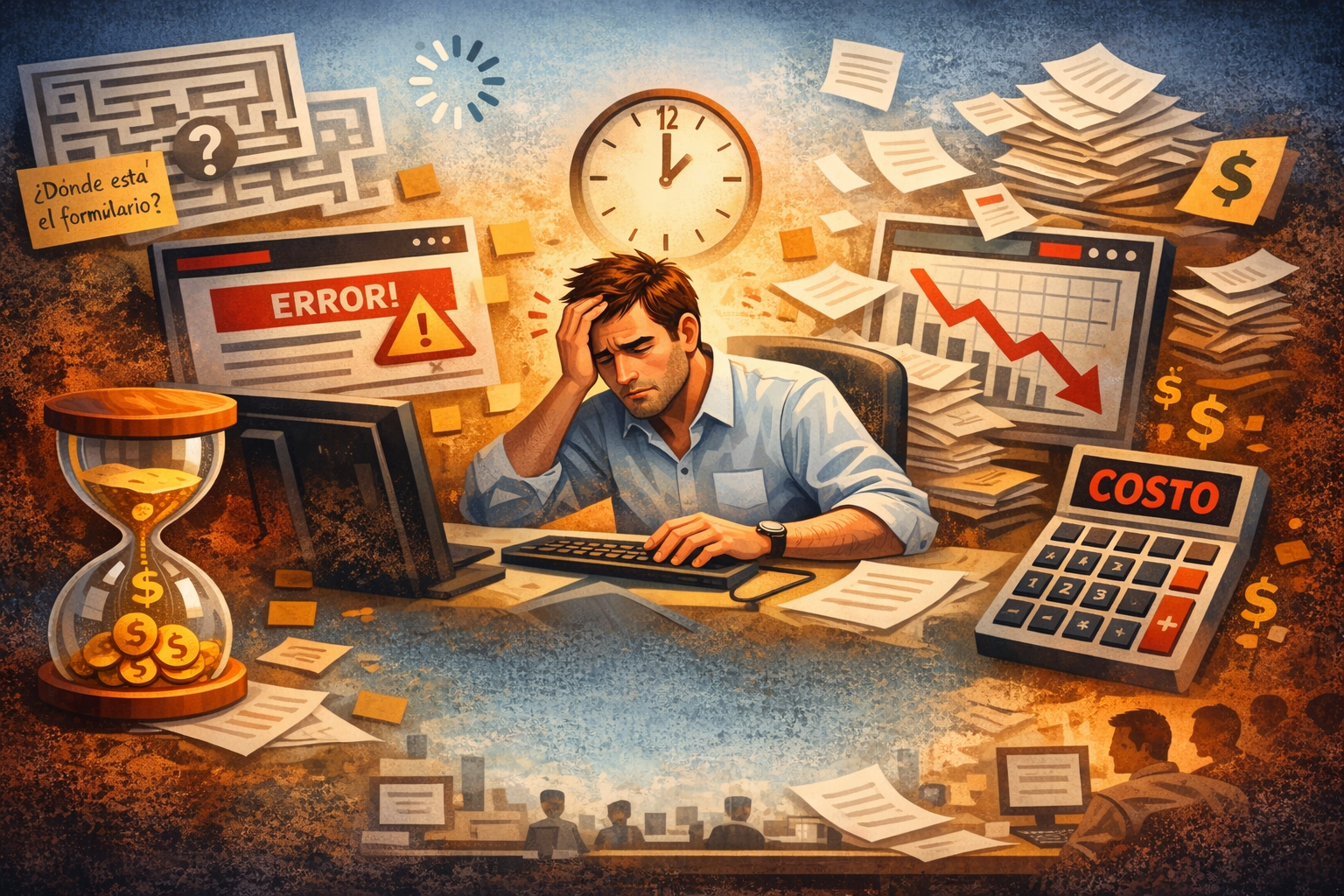
Picture this: an employee needs to submit an expense report. They open the internal system, search for the right form across three illogical menus, fill out fields they don't understand, the system crashes, they start over. What should take 2 minutes ends up taking 15. Multiply that by 50 employees, 5 days a week, 52 weeks a year.
That's not a technology problem. That's a design problem.
And it has a cost that almost no one is measuring.
The Problem No One Sees
When we talk about UX/UI, most people think about apps, websites, digital products for the end customer. But there's an entire universe of internal tools — CRMs, ERPs, dashboards, management systems, communication platforms — where design is treated as a luxury instead of a necessity.
The result is predictable: frustrated teams, slow processes, and a silent loss of money and talent.
The numbers confirm it:
- Every dollar invested in UX returns $100. That's a 9,900% ROI (Forrester).
- Good technology improves worker productivity by up to 40% (Emotiv, neurological research).
- 62% of employees feel uninspired or disengaged from their work (Gallup). The tools they use every day are part of the problem.
- 71% of employees expect their company's technology to match the quality of what they use in their personal lives (Salesforce).
We're not talking about making things "prettier." We're talking about making things work.
5 Ways Bad UX Drains Your Company's Resources
1. Time Lost on Simple Tasks
Every unnecessary click, every confusing screen, every mislabeled field adds up. Inefficient digital processes cause up to a 30% annual increase in IT costs (IBM). Not because the technology is bad, but because no one designed the experience with the actual user in mind.
2. Never-Ending Onboarding
A new employee should be able to use company tools in days, not months. Yet there are organizations where employees take up to 6 months to reach full productivity because internal systems aren't intuitive. That's half a year of salary performing at half capacity.
3. Avoidable Errors
Confusing interfaces generate human errors. Errors that someone then has to detect, correct, and document. A poorly designed form can cause incorrect data that propagates through the entire decision-making chain. The cost isn't just in fixing the error — it's in the wrong decisions made with that information.
4. Talent Turnover
This is the least measured and most painful cost. When a salesperson has to fight a hostile CRM every day, they eventually leave. And the cost of replacing them is between 50% and 200% of their annual salary. A case documented by UserTesting showed that a poorly designed internal interface caused salespeople to quit, generating a double productivity cost: the loss of the trained employee plus the time to train a replacement.
5. Resistance to Change
When a company implements a new tool and the experience is bad, people go back to spreadsheets, sticky notes, and the manual processes they've always used. The technology investment is lost. Not because the tool doesn't work, but because no one wants to use it.
What Good UX/UI Actually Looks Like
The difference between a well-designed internal tool and a poorly designed one isn't cosmetic. It's operational.
| Without UX/UI Design | With UX/UI Design |
|---|---|
| Employees need training for every task | The interface guides users step by step |
| Data entry errors are frequent | Validations prevent errors before they happen |
| Information is scattered across multiple screens | Relevant data is where it's needed, when it's needed |
| The team avoids using the system | The team adopts the tool because it simplifies their work |
| Every update causes confusion | Changes integrate naturally into existing workflows |
Companies that lead in design generate 32% more revenue and 56% higher shareholder returns than their competitors, according to a McKinsey study that analyzed 300 companies over 5 years.
That's not a coincidence. That's design.
How to Tell If Your Company Has a UX Problem
Before looking for a solution, you need to know if you have a problem. These five questions will give you clarity:
1. How long does it take to complete routine tasks?
If entering data, generating a report, or approving a request takes longer than it should, the problem is likely the interface, not the person.
2. How many questions does your IT team get about how to use your systems?
If internal support is essentially a help desk for your own tools, the interface isn't communicating what it should.
3. How many workarounds exist?
Parallel spreadsheets, paper notes, WhatsApp groups to coordinate what the system should handle. Every workaround is a symptom of poor design.
4. How was adoption of the last tool you implemented?
If the answer is "nobody uses it," the problem isn't the tool. It's the experience.
5. How long does it take a new employee to become productive?
If tool onboarding is a long and painful process, you're paying the poor design tax every time you hire someone.
If you answered "yes, that happens" to three or more questions, your company is leaving productivity — and money — on the table.
Design Is Not an Expense. It's Infrastructure.
There's a reason the world's most successful companies invest aggressively in design: they understood that user experience isn't a coat of paint you add at the end. It's the foundation everything else is built on.
A team that works with well-designed tools is a team that:
- Makes fewer errors
- Needs less training
- Adopts changes faster
- Gets less frustrated
- Performs better
And in a market where talent is scarce and efficiency is everything, that's not a luxury. It's a competitive advantage.
Where to Start
You don't need to redesign everything overnight. The first step is an experience audit: mapping current workflows, identifying the most critical friction points, and prioritizing the changes that will have the greatest impact.
At Vortwood, that's exactly what we do. We help companies transform their internal tools and digital products into experiences people actually want to use — because when design works, everything else works better.
If you think your team is paying the poor design tax, let's talk.